

Massage Services
Deep tissue massage in Daly City, priced by the hour
Four lengths, four prices, and hot stones, cupping and a hot compress at no extra charge.
The short answer
Deep tissue massage at Sweet & Smile runs $45 for 30 minutes, $80 for 60 minutes, $110 for 90 minutes and $150 for 120 minutes. Hot stones, cupping and a hot compress are included at no extra charge. We are at 6175 Mission St, Daly City, open daily 10 AM to 9 PM.
- 60 minutes of firm-pressure deep tissue work
- $80
- lengths on the ladder, from 30 minutes to 120
- 4
- included with the booking: hot stones, cupping, hot compress
- 3
- patients across 25 trials in the 2015 Cochrane low-back review
- 3,096
What does a deep tissue massage in Daly City cost?
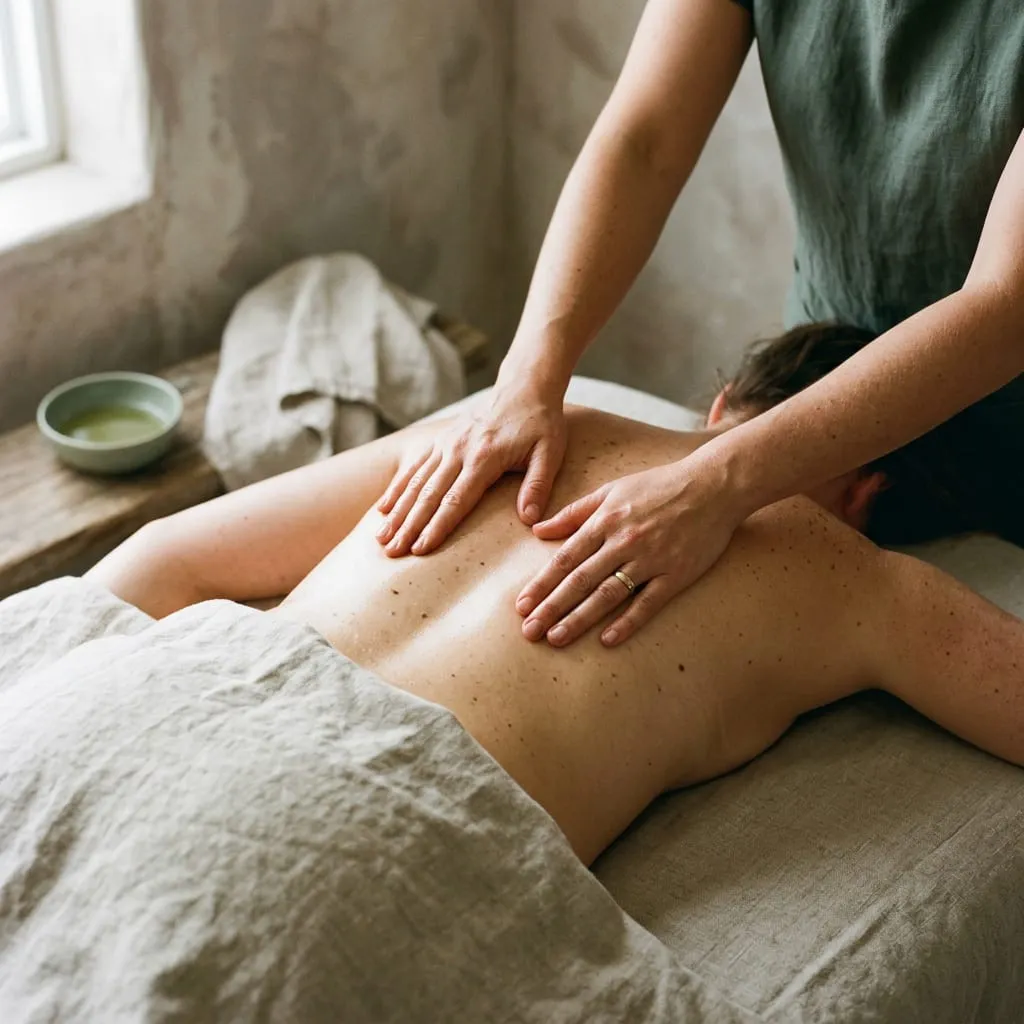
Between $45 and $150, set by length and by nothing else. A deep tissue massage in Daly City at Sweet & Smile runs on a single ladder: 30 minutes at $45, 60 at $80, 90 at $110 and 120 at $150. Hot stones, cupping and a hot compress come with the booking at no extra charge, which is the part most menus on this corridor charge for.
Add-ons are $20 each for 15 minutes — foot, scalp or abdominal — and they attach to any of the four lengths. Nothing on that list costs more because you asked for firmer work.
Two things decide the length, and neither of them is the budget. The first is how many regions need work: one shoulder is a half hour, a back-and-shoulders job fills an hour, and a full body with one problem area worked through twice needs 90. The second is how long it takes you to stop guarding — some people are still braced at minute 15, and for them the 120 minute booking is the first one that gets past it and into the tissue.
| Length | Price | Per minute | What it realistically covers |
|---|---|---|---|
| 30 min | $45 | $1.50 | One region — a shoulder, a lower back, a pair of calves |
| 60 min | $80 | $1.33 | Back, neck and shoulders with time to settle first |
| 90 min | $110 | $1.22 | Full body, or one stubborn area worked through twice |
| 120 min | $150 | $1.25 | Full body plus hips, forearms and feet, unhurried |
How do you ask for more or less pressure?
Out loud, in plain words, at any point in the session. A therapist cannot feel what you feel, and the calibration that suited the person on the table an hour ago can be wrong for you by a wide margin. Therapists expect to be told and adjust on the spot, so there is no need to wait for a break in the work.
Before you are on the table
Name the area and the job it has to do. "Right shoulder blade, I drive for a living, go as deep as you can there and stay light on my neck" gives a therapist far more to work with than "deep tissue, please". Say it in the room rather than typing it into a booking note, which nobody can read once their hands are busy.
In the first five minutes
Ask for a calibration pass. "That is about a 6 out of 10 — can you take it to an 8 here and a 4 on my lower back?" The numbers do not have to be precise or scientific; they give both of you one shared dial instead of two private guesses.
What deep tissue means in practice
Deep tissue describes how a therapist works rather than how hard. Strokes run slower, the angle crosses the muscle instead of following it, and a forearm or elbow takes over from the thumb where more surface area does the job better. A slow pass at moderate force reaches further than a fast one at maximum force, which is why a well-delivered deep tissue hour usually feels more thorough and less punishing than people brace themselves for.
Mid-session, when the answer changes
Say "lighter there" or "more, and slower". Adjusting costs no time and offends nobody, and a therapist would much rather hear it at minute 20 than learn at the door that the whole hour had been wrong.
- Both "too much" and "not enough" are useful to hear; staying quiet through an uncomfortable hour helps nobody and wastes the booking.
- Breathing out as a therapist leans in makes firm work far easier to take than bracing your body against it.
- If you are holding your breath or gripping the edge of the table, the pressure has passed the useful point and it is time to say so.
- An elbow or forearm feels deeper than a thumb at the same force — ask for a different tool rather than less depth if a deeper feel is what you want.
Is it supposed to hurt, and is soreness afterwards normal?
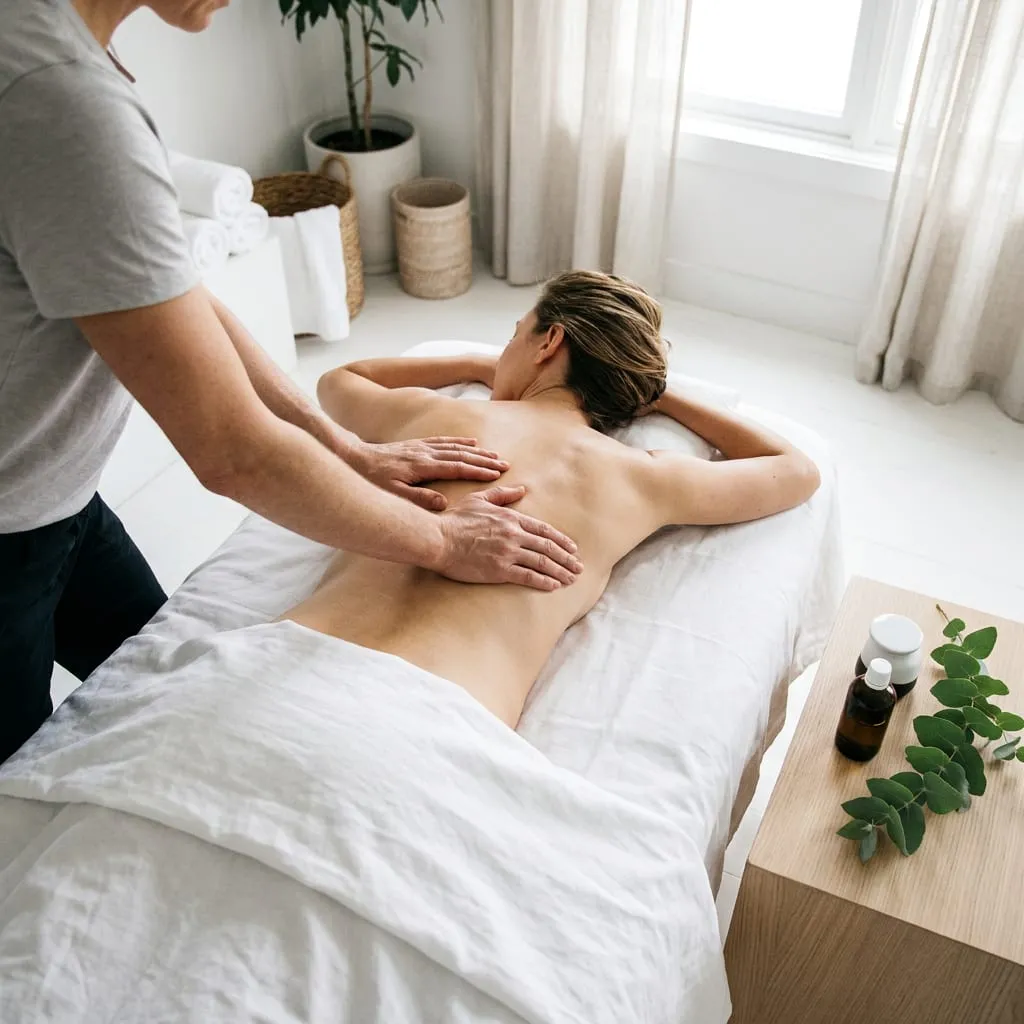
Firm work can be uncomfortable while it is happening, and a day of dull, gym-like soreness afterwards is common enough to plan around. Sharp, electric or radiating sensation belongs in a different category, and the response to it is to say something immediately rather than to breathe through it politely.
Drink water, keep moving gently, and expect ordinary soreness to fade within 24 to 48 hours. If it is still with you on the third day, or if anything felt sharp during the session, that is a conversation with your own clinician rather than a reason to book again sooner.
The complimentary hot compress earns its keep on the way out. Heat over the area that was worked, gentle movement through the rest of the day, and water will keep next-morning stiffness inside the manageable range. Skip the hard gym session that evening and take a walk instead.
NCCIH describes the risk of harmful effects from massage as low, and is specific about where the rare reports of serious harm cluster: blood clots, nerve injury and bone fractures, mostly in connection with vigorous techniques such as deep tissue work, and mostly among people already at higher risk of injury. If you take blood thinners, have osteoporosis, or are being treated for anything affecting circulation, that conversation belongs with your doctor before it belongs with the front desk.
Does deep tissue help back pain?
The evidence is real, modest and short-lived, which is a more useful answer than either yes or no. A 2015 Cochrane review pooled 25 trials covering 3,096 people with low-back pain and found short-term improvement in pain after massage, while stating that the reviewers had very little confidence in the result because the underlying studies were of low quality.
The agencies that review this literature land in much the same place. The Agency for Healthcare Research and Quality examined 20 studies in 2016 comparing massage with usual care or with other treatments, found evidence that it helped chronic low-back pain, and rated the strength of that evidence as low; a separate look at 6 studies pitting massage styles against one another found the evidence too thin to say whether any style beats any other. Choosing deep tissue over Swedish is a preference about how an hour should feel rather than a bet backed by trial data.
A 2011 randomized trial of 401 adults with chronic low-back pain is the more useful study for choosing a booking. At 10 weeks, the relaxation-massage group scored 2.9 points lower on the Roland Disability Questionnaire than usual care, and structural massage — the targeted, technique-heavy kind — did no better than plain relaxation work.
Length looks more important than style, at least in the neck literature. A 2014 trial randomized 228 people with chronic neck pain to different doses of massage across four weeks: 30 minute sessions performed no better than a wait list, while 60 minute sessions two or three times a week roughly tripled to quintupled the odds of a clinically meaningful improvement in neck function.
Read together, that argues for the 60 minute booking over the half hour when a problem is chronic, and for repeating it across several weeks rather than expecting one appointment to undo something that took months to build. NCCIH also warns against using massage to postpone getting a medical problem looked at, which is the piece of that advice nobody should skip. Our back pain evidence guide works through the same studies at more length.
Thirty minute sessions performed no better than a wait list. Sixty minute sessions, two or three times a week, moved the numbers.
Who should book Swedish instead?
Anyone whose goal is to relax rather than to be worked on. Swedish Massage is $70 for 60 minutes and $100 for 90, uses long flowing strokes at comfortable pressure, and carries the same complimentary hot stones, cupping and hot compress as the firmer bookings.
- First massage ever, or first in several years: start with Swedish and ask for firmer as you go, rather than starting deep and enduring it.
- Pregnant: book Prenatal Massage at $90 for 60 minutes, which is side-lying and supported and leaves out the stones and cupping.
- Puffiness and heaviness rather than tight muscle: Lymphatic Drainage at $120 for 60 minutes is light rhythmic work and an entirely different treatment.
- Mostly the neck, shoulders and base of the skull: the Neck, Shoulder & Head Pain Relief Massage at $90 for 60 minutes spends the whole hour in that triangle.
- Cold through to the bone as well as sore: Himalayan Salt Stone + Sound Therapy takes a different approach to the same tired body.
Where are you, and when can you get in?
6175 Mission St, Daly City, CA 94014, open 10 AM to 9 PM every day, on (415) 916-3282. We are in the row of storefronts on the Mission Street corridor in Daly City's Top of the Hill district, on the Daly City side of the San Francisco line, which is an older street of small shops rather than a mall setting.
Getting in after a shift is the usual question. Because the doors close at 9 PM, a 60 minute session has to start by 8 PM, a 90 minute one by 7:30 PM and the 120 minute booking by 7 PM — which makes a deep tissue massage in Daly City a weekday possibility rather than a Saturday-only plan. Walk-ins are welcome when a room is free, and Square shows live availability for anyone who would rather not gamble on it.
Daly City BART is about half a mile west-southwest at 500 John Daly Blvd, usually a 10 to 15 minute walk, with a park-and-ride of roughly 2,000 spaces for anyone driving up from further down the Peninsula. The Muni 14 Mission runs along Mission Street outside the door and operates 24 hours. Street parking is metered Monday through Saturday, 8 am to 6 pm, with no hourly fee on Sundays or legal holidays — check the posted signs.
Inside, the tables are oversized, so a pair of shoulders that hangs off a standard table rests on this one; every room runs its own air purifier, and linens are fresh for every guest.
Bring nothing. You will change in the room and lie under a sheet, undressed to whatever level suits you, while the therapist steps outside. Payment and gift cards both run through Square. If you are coming straight off a job site, the bathroom is there and nobody minds work clothes or boots in the hallway.
Questions people ask
How much is a deep tissue massage in Daly City?
$45 for 30 minutes, $80 for 60, $110 for 90 and $150 for 120. Hot stones, cupping and a hot compress are included at no extra charge, and 15 minute add-ons — foot, scalp or abdominal — are $20 each. Booking runs through Square, or call (415) 916-3282 and we will sort it out.
Will deep tissue hurt?
It can be uncomfortable while a therapist works through a tight area, and a day of dull soreness afterwards is common. Sharp or radiating pain falls outside that, and saying so mid-session is expected rather than rude. Pressure gets adjusted on the spot, as often as you need it adjusted.
Should I book 60 or 90 minutes?
Book 60 minutes when one or two regions are the problem, and 90 when you want a full-body pass with the sore area worked through twice. The 2014 neck-pain dose trial found half-hour sessions no better than a wait list, so treat the 30 minute booking as a top-up rather than a first appointment.
Are the hot stones and cupping really free?
Yes, on a standard massage booking, with no upsell at the desk. They are left off Prenatal, both lymphatic drainage services and the Himalayan Salt Stone session, where added heat or suction would work against what the treatment is doing. Ask for them as the session starts so the therapist has everything ready.
Is deep tissue safe if I take blood thinners or have osteoporosis?
Ask your own clinician first. NCCIH reports that the rare cases of serious harm from massage — blood clots, nerve injury, bone fractures — cluster around vigorous techniques and people already at higher risk of injury. Tell us what you are managing when you arrive, and a therapist will work lighter or leave an area alone.
What if deep tissue turns out to be too much for me?
Tell the therapist and the session becomes a lighter one at the same price, with no renegotiation at the desk. If firm work has never suited you, book Swedish at $70 for 60 minutes instead; it uses the same room, the same oversized table and the same complimentary hot stones.
Sources
- NCCIH — Massage Therapy: What You Need To Know
- NCCIH — Massage Therapy for Health: What the Science Says
- NCCIH — Chronic Pain and Complementary Health Approaches
- AMTA — Massage Can Improve Health and Wellness
Written and fact-checked by the Sweet & Smile editorial team against the primary sources above. Sessions at our Daly City studio are performed by experienced massage therapists.
This guide is for general education only and is not medical advice. Talk with your healthcare provider about what is right for you.
Four lengths, one price list
Deep tissue on the Mission Street corridor, 30 to 120 minutes
Deep Tissue runs $45 for 30 minutes, $80 for 60, $110 for 90 and $150 for 120 at 6175 Mission St, Daly City, with hot stones, cupping and a hot compress included. Open 10 AM to 9 PM daily; walk-ins welcome when a room is free, or call (415) 916-3282.
Sweet & Smile Massage · 6175 Mission St, Daly City, CA 94014 · (415) 916-3282 · Open daily 10 AM – 9 PM.